Centralia in the Arts
The Centralia mine fire has inspired an astonishing number of novels, plays, films, poems and photography projects. Here are the ones I know about:
Novels
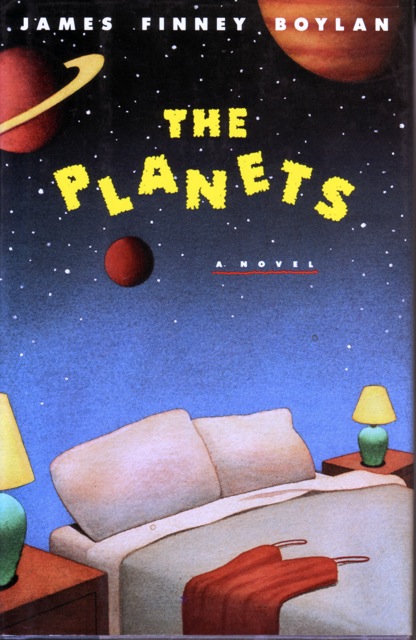
James/Jennifer Finney Boylan set two novels in Centralia
The Planets, Poseidon Press, 1991, and The Constellations, Random House, 1994, both by James Finney Boylan. Both are about people who live in Centralia during the time of the mine fire. The author is a transgender woman and now writes under the name Jennifer Finney Boylan. She occasionally contributes op-ed pieces to The New York Times. More about her other books here.
Strange Highways, Dean Koontz, Warner Books. A failed author returns to his hometown after many years to attend his father’s funeral, only to find himself suddenly and inexplicably thrust back through time to relive a traumatic event from his past. Koontz says in the introduction that Centralia was the inspiration for the story, which is a novella that opens this collection of his short fiction. 1995.
Those Who Favor Fire, by Lauren Wolk. Uses a town like Centralia and elements of the Centralia story as backdrop for a love story. Random House, 1999.
The Revolutionary’s Confession, by George Grayson. Lost Chinese treasure and the mines beneath Centralia. The fate of the world is at stake. Poseidon Press, 2000.
Coal Run,by Tawni O’Dell. “A poignant tale of a once-proud Pennsylvania coal town destroyed by a mining disaster, Tawni O’Dell’s second novel, Coal Run, follows its wounded inhabitants as they try to come to terms with what is gone and what remains.”–Michael Ferch review on Amazon.com. 2004.
Dirty Blonde, by Lisa Scottoline. U.S. District Judge Cate Fante, the main character in this crime novel, grew up in Centralia before going away to college and becoming a Federal judge in Philadelphia. In one part of the book, she returns to Centralia to visit her mother’s grave in St. Ignatius Cemetery and to view what little is left of her ruined hometown. Lisa hired me to check her manuscript for accuracy, which was pretty good even before the minor changes I suggested. Harper. 2006.
Vampire Zero, by David Wellington. A deadly vampire is tracked back to Centralia. This novel isn’t bad as this genre goes. I only came across it recently. Conventionally published in 2008 by Three Rivers Press, an imprint of Penguin Random House, meaning not self-published. Several central Pennsylvania towns in addition to Centralia are mentioned. The author, who now lives in New York City, has written a series of novels about vampires, zombies, and I think werewolves.
The Hollow Ground, by Natalie S. Harnett. This novel is a fictional account of an 11-year-old girl, Brigid Howley, dealing with the terror of both the Centralia and Carbondale (the towns are given different names) mine fires in Pennsylvania in the 1960s. The Howley family is descended from one of the Mollie Maguires cursed by the Centralia priest, Father Daniel Ignatius McDermott, after they beat him in 1869 for denouncing their murder in 1868 of Alexander Rea, the founder of Centralia. The priest, according to legend, also cursed Centralia itself for harboring the murderers, and predicted the day would come when only the church remained standing. As many of you know, that corresponds to what happened in real life, although it was Transfiguration of the Blessed Virgin Mary Ukrainian Catholic Church, not St. Ignatius Catholic Church, that remained standing. Published in 2014 by Thomas Dunne Books, a now-shuttered imprint of St. Martin’s Press.
Centralia, PA: Devils Fire, by Andrew Shecktor. The author, a Berwick resident, novelizes the Centralia story, drawing from my book and a few other sources. Read it if you must. Self-published, 2014.
Centralia: A Novel, by Mike Dellosso. A Christian horror thriller about a man returning to his abandoned hometown, only to find supernatural horrors lurking in the smoke-filled streets. Dellosso is an adjunct professor of writing at Lancaster Bible College in Lancaster, Pennsylvania. Tyndale House Publishers, 2015.
The Loner: An Aubrey McKenna Mystery Novel, by Greg Dillensnyder, a retired psychotherapist from Pittsburgh. “Aubrey McKenna, chief investigator for the Schuylkill County District Attorney, is approaching a ‘crossroads’ decision about her career when she accepts an invitation to evaluate strange, middle-of-the-night activity on Graffiti Highway in deserted Centralia, Pennsylvania. A crime cartel’s sinister logo has appeared among the colorful mile-long smorgasbord of other drawings that decorate the old, abandoned highway…” Proving once again that the Centralia mine fire is the perfect canvas for any number of novels, etc.
This book was published by Pine Circle Publications in 2020 but obviously was written before that day in April, 2020, when a convoy of dump trucks from Pagnotti Enterprises covered Graffiti highway (and presumably the crime cartel’s sinister logo) with piles of dirt. Pine Circle Publications appears to exclusively publish Dillensnyder’s books.
A.I.
Smoke Without End: The Story of Centralia, by John Frances. This appears to be at least in part, if not entirely, A.I.-generated. Only two actual names, Alexander Rea, the founder of Centralia, and Todd Domboski, who narrowly escaped death in a mine fire subsidence at age 12 in 1981, appear in the book. The rest reads as if my book and all the others about Centralia were forcefed into A.I. software, which then spit out broad, nameless generalizations and summations about what happened in Centralia because of the mine fire. Part of his outline and chapter notes appear, probably in error, on p. 25. No sources for the information he presents are included. “John Frances,” a name from nowhere if there ever was one, is the purported author of 16 books, most published between July and October 2025. The topics, which range from “Ash and Bread: Life and Labor in America’s Coal Towns,” to “Hard Lives, Soft Hearts: The History of the Coal Region in Pennsylvania,” seem geared to hook unsuspecting readers. The publisher of the Centralia book is Lightning Source, L.L.C. of Chambersburg, PA. Don’t waste your money.
Drama
The Root of Chaos, by Douglas Soderberg. First performed by Actor’s Theatre of Louisville, Nov. 10, 1984. Performed Off-Off Broadway, 1987. Summerworks, Toronto, 1992.
Centralia, by Deryl B. Johnson. Performed at Kutztown University, 1998.
Centralia, a comedy troupe loosely inspired by the town with the mine fire. WestBeth Theater, New York City. I know they performed on June 10, 2001.
Inferno, Squonk Opera, Pittsburgh. As if Fellini or Ken Russell did the Centralia story. A rock opera. Very good. 2003. You can hear the soundtrack on Apple Music or Spotify.
Centralia: A Nice Place to Live. About the nine remaining Centralia residents. Ugly Rhino Productions. Performed on Friday nights during March 2012 at the Brooklyn Lyceum in Brooklyn, N.Y.
For Centralia, by Amanda Hodes. A sensory and poetic mood piece about Centralia intended to be listened to while one is slowly driving a specific route in the former town. I listened to it at home, and really liked it. Hodes is a lecturer in creative writing (poetry) at Oberlin College in Ohio. Released in 2015.
Films
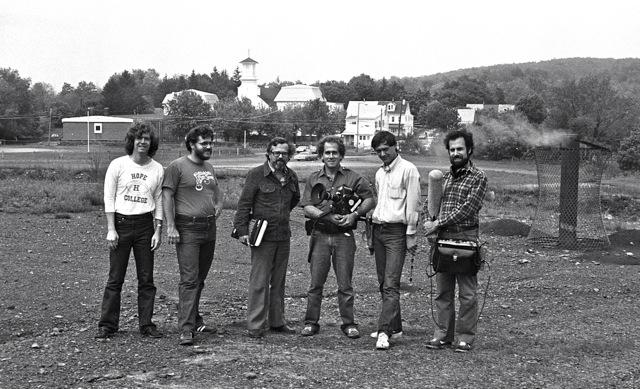
Crew of “Centralia Fire,” July 4, 1982
Centralia Fire, directed by Tony Mussari. Documentary, part of PBS Matters of Life and Death series. 1984. Narrated by actor Martin Sheen. Bob Achs, uncle of the actors Jake and Maggie Gylenhaal, was the director of photography. Dariusz Wolski, much later the director of photography on Pirates of the Caribbean 1 & 2, Sweeney Todd, The Martian, Napoleon, and other fine films, was an assistant camera. Stan Leven, who had a long career at WGBH in Boston, was the sound recorder. I was the consultant but don’t appear. You can watch this on YouTube.com. Here is the link.
Made in USA, a feature film starring the late Christopher Penn (brother of Sean), Adrian Pasdar and Lori Singer. Filmed in Mount Carmel, Centralia, and Harrisburg, Pa. Released direct-to-video in 1988. Re-released on video, 1999. About two dudes who get fed up with life in a town with a mine fire and head out across country.
Nothing But Trouble, 1991, starring Dan Aykroyd, Chevy Chase, Demi Moore and John Candy. One of the worst films ever made, but an underground mine fire is an important plot element. See it if you must.
Silent Hill, 2006, is about an abandoned town above a mine fire. The town in the original Japanese video game was a seaside village with no mine fire. Screenwriter Roger Avary, who had heard stories about the Centralia mine fire from his mining engineer father, decided a town like Centralia worked better for the story. The road into Silent Hill is closed off, as the old Route 61 into Centralia is, and the underground fire forced most residents to leave. Of course, the real Centralia didn’t have demons living beneath it as far as anybody knows.
The Town That Was, 2007, directed by Chris Perkel and Georgie Roland. Produced by Melinka Thompson-Godoy. I was the consultant and appear in the film, which you can view on YouTube.com. A feature-length documentary about Centralia and the handful of residents who refused to leave the town with the mine fire. Central character in the story is John Lokitis, Jr., then in his mid-thirties and the youngest of the remaining residents. Lokitis denies the mine fire is a problem and tries to preserve a semblance of what Centralia used to be. He mows lawns and hangs the municipal Christmas decorations. John was forced to leave Centralia in the summer of 2009 as part of a final state effort to remove the remaining residents. His house was demolished in December 2009, by which time he had moved to nearby Ashland. You can find The Town That Was on YouTube.com. Chris has continued to direct documentaries, including an acclaimed one on popular music impresario Clive Davis, and is the creative director of the annual Coachella Festival in southern California.
Centralia: Pennsylvania’s Lost Town (2017), directed by Joe Sapienza II. I was a consultant and appear in this new feature-length documentary on Centralia and the mine fire. Here is the trailer on YouTube.com. The full-length movie isn’t presently available online. This began as a student film when Joe was in the Drexel University film program in Philadelphia. You’ll see about 85 of my Centralia photos in the film.
Poetry
The Centralia Mine Fire, by Leonard Kress. Flume Press, 1987. A collection of poetry, but only the title poem is about Centralia.
So Long the Sky, by Mary Kovaleski Byrnes. Platypus Press, 2018. The poet, who is on the faculty of Emerson College in Boston but is from Pennsylvania, writes movingly about Centralia, Byrnesville, the mine fire, and assorted other topics.
Photography
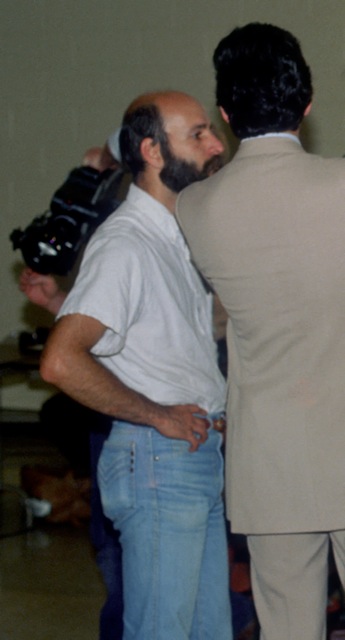
Stephen Perloff, photographer
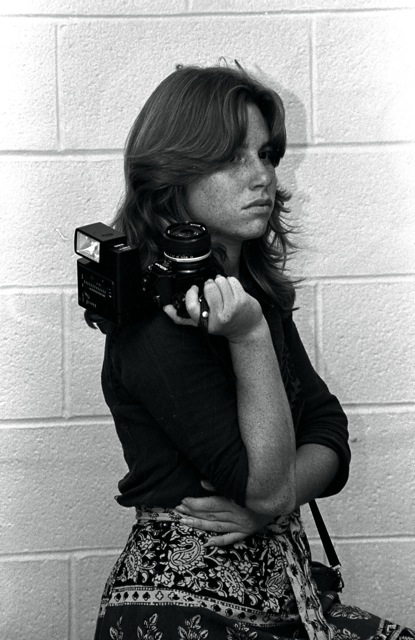
Renee Jacobs, photographer
Centralia, by Stephen Perloff, editor then and now of Photo Review magazine, Philadelphia, Ten gallery exhibitions, the first major one in 1984.
Slow Burn: A Photodocument of Centralia, Pennsylvania is a photography book by Renee Jacobs that included interviews with Centralia residents and text by Margaret O. Kirk. University of Pennsylvania Press, 1986. New edition from Penn State Press, 2010. Jacobs’ Centralia photographs were exhibited in the Book Trader Gallery, Philadelphia, in December 1986.
Comic Books & Graphic Novels
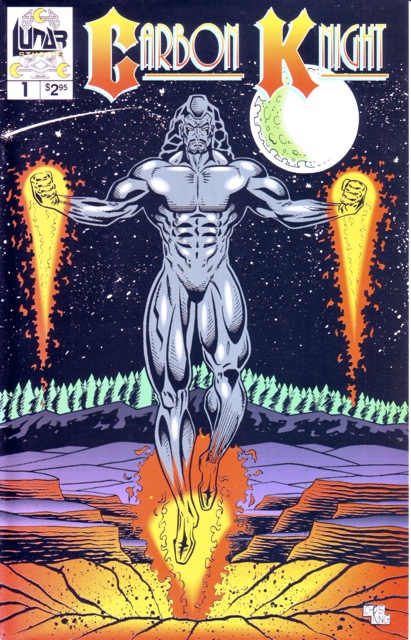
Carbon Knight, a superhero, was forged in the fires of Centralia
Carbon Knight, by Chris Ring, 1998. Centralia fire chief Kyle McKnight fights corrupt forces who want to let the mine fire continue burning. They throw him into a burning pit and leave him for dead. Thirty years later, he rises from the fire as a half-man, half rock creature with super powers.
Centralia: Wandering in a World on Fire, written and drawn by Miel Vandepitte, a Belgian author and artist. 2024 MoCCA Arts Fest Award of Excellence Recipient. “The earth in and around Centralia has warmed so much, it’s impossible to stand on without melting. Those who survive long enough will be confronted with carnivorous birds, collapsing buildings, and the trigger-happy Simia Nasalis, armed with bazookas and stilts. Against their better judgment, a group of adventurers set out to discover the treasure of gold hidden away at the heart of the abandoned town.” English language translation published 2023 by Living the Line.
Nonfiction Books
Unseen Danger: A Tragedy of People, Government and the Centralia Mine Fire, by David DeKok. My first book, a comprehensive history of the Centralia mine fire, published in 1986 by University of Pennsylvania Press. It was reviewed at length in the Sunday New York Times Book Review of January 4, 1987. This book is no longer in print, but all of it is incorporated in Fire Underground from 2009 (see below)
The Real Disaster Is Above Ground: A Mine Fire and Social Conflict, by J. Stephen Kroll-Smith and Stephen Robert Couch. It really wasn’t. This book shows why academic writing is so often such a turn-off to the general reader. It takes a fascinating topic, wrings out everything remotely interesting, and then attacks the press for not doing the same. I really hate this book. University of Kentucky Press, 1990.
A Walk in the Woods, 1998, by Bill Bryson. The eminent Bryson ambles off the Appalachian Trail, the main topic of his book, to explore Centralia, even stopping at the Mount Carmel Public Library to look at its famous clip file on the Centralia mine fire. Many of the clips are stories I wrote for The News-Item in Shamokin, PA, from 1976-86.
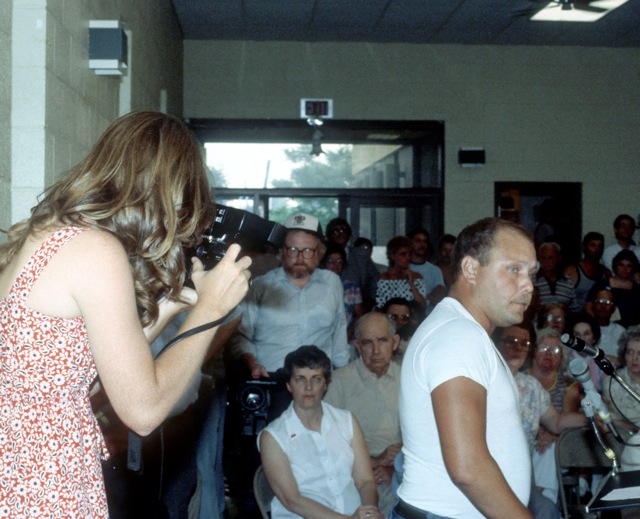
Renee Jacobs photographs Charlie Gasperetti, citizen activist in Centralia
Centralia, by Deryl B. Johnson of Kutztown University, Arcadia Publishing. Johnson also wrote the play Centralia mentioned elsewhere on this page. His new, 128-page softcover book is a tribute to the borough of Centralia and its people and contains historic photos contributed by Tom Dempsey and others. 2004.
Pennsylvania Disasters: True Stories of Tragedy and Survival, by Karen Ivory. Chapters on many of the various disasters to have befallen the Keystone State, including the Centralia Mine Fire. Insider’s Guide, an imprint of Globe Pequot Press. 2007.
The Day the Earth Caved In, by Joan Quigley. Not to be confused with Joan C. Quigley, the astrologer for Nancy Reagan. She gets the origin of the mine fire very wrong, but digs up some interesting personal stuff about some of the key people involved in the story. Her narrative suffers, though, from the absence of Joan Girolami, the leading citizen activist, who declined to be interviewed. Joan G. retired to Florida with husband Lou and tried to keep the mine fire in her past after moving to the Sunshine State. Both have sadly passed. Random House, 2007.
Fire Underground: The Ongoing Tragedy of the Centralia Mine Fire, by David DeKok. An updated edition of Unseen Danger that brings the story up to 2009. Three additional chapters and many more of my photographs. The original printing had some of the photos in color. Globe Pequot, 2009.
The Absence Above, A Presence Below: Re-Envisioning Centralia, Pennsylvania, by John G. Sabol, Jr. He riffs on passages from my book, my website, and other source material about Centralia. Uses three of my photos without permission. I give him credit for finding more three more novels set in or touching upon Centralia than I was aware of. Published by Ghost Excavator Books, 2013, but this appears to be self-publishing.
Fifty Years a Bureaucrat, or How to Really Get the Job Done, by John G. “Jack” Carling. Carling was the Pennsylvania Department of Community Affairs official in charge of the Centralia relocation. In this memoir, he talks about his entire career in disaster response, but devotes several chapters just to Centralia. I found Jack to be a caring, competent public official who did the best he could for Centralia, going above and beyond the minimum required. He died in December 2024. Published by the Lackawanna County Historical Society, 2014.
Centralia Mine Disaster: Unnatural Disasters, by Julie Knutson. A very basic history of the mine fire. I wonder if it is intended for school audiences? Cherry Lake Press, 2021.
Telling of the Anthracite: A Pennsylvania Post History, by Philip Mosley. Mosley looks at how we tell the Pennsylvania anthracite story in the postindustrial age. Centralia gets a lot of attention. Oxford Southern, an imprint of Sunbury Press, 2023.
Songs
(There may be other songs about Centralia that I haven’t been able to find. If you know of one, feel free to email me at ddekok@mac.com. Note to songwriters: maybe try different titles besides “Centralia” or “Centralia Mine Fire”?)
––Gerry McWilliams, “Centralia,” 2001. Lives in Jeffersonville, PA, which is in Montgomery County by Philadelphia.
––Akira Yamaoka, Theme from “Silent Hill,” 2006. Spooky music from the film, which was about a young boy lost in a town under which a mine fire burned, and which was populated by demons.
––Car Bomb, “Centralia,” 2007. A mathcore band, i.e., noise with lyrics. Makes Yoko Ono sound like Julie Andrews. They hail from Rockville Centre, NY, but have roots in Bushwick, Brooklyn. They adopted “Centralia” as the title of their first album, choosing it because it is the all-purpose metaphor. But none of the songs have anything directly to do with Centralia, Pennsylvania.
––Ken Battista Band, “Centralia,” in 2009. A jazzy lament from one of Philadelphia’s top wedding and party bands.
––Unknown singer, “The Fires of Centralia,” recording captured by Jay Yanch during a performance at Francis Slocum State Park near Wyoming, PA, in 2011. Does anyone know who the singer is? The story he tells in his introduction about fumes from the mine fire drifting into a Centralia Borough Council meeting is apocryphal, as far as I know.
––Pat Poidevan, an indie folk musician from Eastern Canada, recorded “Centralia, PA” in 2013 as part of his “American Fiction” album. The video was shot near the Bay of Fundy in New Brunswick.
––Martin Lan, “Fire Down Below (Song for the Town of Centralia, PA), 2014. I could find no information about the singer.
––Bluegrass musician Pete Smith and the Raven Hill bluegrass band from Phoenixville, PA, wrote and recorded “Nothing in Centralia,” which tells the story of Centralia and the mine fire in the traditional bluegrass style. Recorded live in 2014.
––Shannon Kealey Band, “Centralia,” recorded life in 2015 in San Jose, California. Kealey grew up in the Bay area and lives there now, but spent several years living and performing in New York City. Love the mandolin and dobro on this Americana recording.
––David Wayne Moore, “A Cry for Centralia,” recorded in 2016 for Joe Sapienza’s documentary, “Centralia: Pennsylvania’s Lost Town.” Moore is from Philadelphia.
––Big Sky String Band, “Centralia.” Hints of the Flying Burrito Brothers. The band is from Chicago. 2016.
––Slagathor, “Centralia Mine Fire.” Doom metal, post-apocalyptic, no words. Once again, Centralia as the all-purpose metaphor. Slagathor is from Santa Rosa, California. 2017
––Antonio Andrade, “Something Happened.” A poignant meditation on life and youth baseball in Centralia from a singer who grew up in the heart of the mine fire impact zone. Antonio performs regularly throughout Central Pennsylvania. 2017.
––Marion Halliday, an Americana singer from Louisville, KY, recorded “Still Burning” in 2018.
––The French Whisperer, said to be a Chilean-born resident of France, recorded “Centralia Mine Fire” in 2020. This is a spoken-word summation in English of the Centralia story, lasting three minutes and 34 seconds, seemingly drawn from my book. It is an ASMR (Autonomous Sensory Meridian Response) recording spoken in a low, deep, French-accented voice and intended for relaxation or falling asleep.
––Jay Smar, “Centralia,” 2022. Smar is a native of Coaldale, Pennsylvania, and now lives in Orwigsburg. He plays accoustic guitar, clawhammer banjo, and fiddle, and performs traditional American folk songs, gospel and bluegrass, original compositions like this one, and coal mining songs of Northeastern Pennsylvania.
––Vanessa Florit, “A Town No More,” undated. Florit’s lyrics for the song can be read at the link, but the link to the song itself is dead. She is a 2004 graduate of Pine Grove Area High School and apparently lives outside of Pennsylvania now.
Rock Bands
“The Centralia Mine Fire,” a rock band from Eureka, Illinois, that performs around the Midwest. I haven’t been able to determine why they picked the name. Here’s their Facebook page.
 David DeKok